
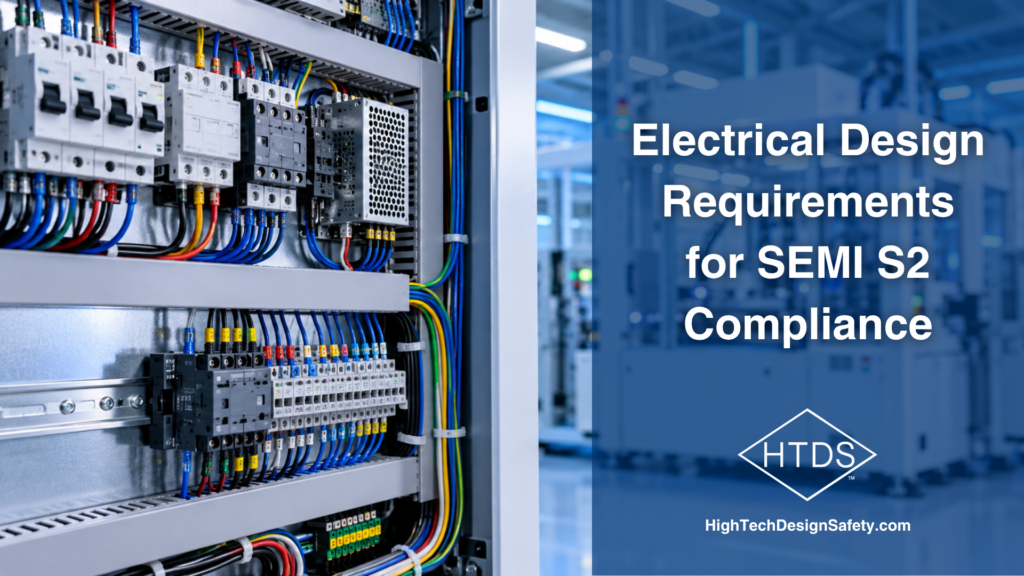
Electrical safety is a critical part of semiconductor manufacturing equipment design. From power distribution and circuit protection to safety interlocks and component selection, every electrical system must be designed with safety and compliance in mind.
SEMI S2 provides environmental, health, and safety guidelines for semiconductor manufacturing equipment. These guidelines help manufacturers identify hazards, evaluate equipment safety, and address potential risks before equipment enters operation.
However, achieving SEMI S2 compliance involves more than selecting electrical components. Manufacturers must also maintain accurate schematics, document critical components, and demonstrate that electrical systems meet applicable safety requirements.
Understanding these expectations early in the design process can help manufacturers reduce compliance challenges, avoid unnecessary redesigns, and prepare equipment for evaluation.
What You Can Expect From the Video and Blog
In this blog, we will explore:
- The role of electrical design in SEMI S2 compliance
- Electrical standards that support SEMI S2 evaluations
- Requirements for electrical schematics and documentation
- Critical Components Lists and component selection
- Circuit protection, grounding, and wiring considerations
- Safety interlocks and emergency-off systems
- How HTDS helps manufacturers address electrical compliance challenges
Understanding Electrical Safety Under SEMI S2
SEMI S2 addresses a broad range of environmental, health, and safety considerations for semiconductor manufacturing equipment. Electrical design is one important part of this evaluation.
Electrical systems must be designed to minimize hazards associated with equipment operation, maintenance, and foreseeable failures.
Additionally, manufacturers must demonstrate that critical electrical components are appropriately rated for their intended applications.
SEMI S2 evaluations may also incorporate requirements from related electrical safety standards, including:
- NFPA 79: Electrical Standard for Industrial Machinery
- IEC 60204: Electrical safety requirements for machinery
These standards provide additional guidance for electrical system design, protection, and documentation.
By considering the applicable standards during development, manufacturers can establish a stronger foundation for electrical safety and conformity.
Complete Electrical Schematics Are Essential
Accurate electrical schematics are among the most important documents used during a SEMI S2 evaluation.
Manufacturers must provide complete drawings that identify electrical devices, connections, and safety-related circuits.
These drawings should include:
- Electrical devices and their corresponding designators
- Power sources and connected loads
- Overcurrent protection devices
- Neutral and grounding connections
- Wire sizes and colors
- Voltage and maximum current information
- Safety interlock circuits
Each electrical device must have an identifiable designator. For example, a circuit breaker may be labeled CB1, while power supplies and other components receive their own identifiers.
These designators must also correspond to physical labels on the equipment, including devices located inside electrical cabinets.
Consistent identification allows engineers and evaluators to compare the electrical drawings with the equipment itself.
Why does this matter?
Incomplete or inaccurate schematics can make it difficult to verify electrical safety. Missing connections, unidentified components, or inconsistent labeling may create additional work during the evaluation process.
Maintaining complete documentation throughout equipment development helps prevent these issues.
Critical Components Lists and Electrical Component Selection
Another important part of SEMI S2 compliance is documenting the electrical components used throughout the equipment.
Manufacturers should maintain a Bill of Materials (BOM) and a matching Critical Components List (CCL).
The Critical Components List identifies electrical components that require particular attention during the safety evaluation.
According to the electrical design guidance, this includes:
- Components operating at line voltage
- Other components operating at 240 VA or above
- Components used within safety systems
Critical components must be appropriately rated for their intended applications.
Additionally, evaluators review applicable UL and Nationally Recognized Testing Laboratory (NRTL) listing information to determine whether components are suitable for their intended use.
For example, a component may have an existing safety certification. However, manufacturers must still consider whether its ratings and intended application are appropriate for the equipment.
Selecting components with suitable ratings and available conformity documentation can help simplify the evaluation process.
Manufacturers should also retain relevant component data sheets and supporting technical information.
Overcurrent Protection and Electrical Distribution
Overcurrent protection is another important consideration in semiconductor equipment electrical design.
Electrical systems often contain multiple circuits, power supplies, and subassemblies. Each must be evaluated for appropriate protection.
During a SEMI S2 evaluation, engineers review the electrical design to identify potential issues with circuit protection.
Common concerns include:
- Missing overcurrent protection
- Incorrectly selected protection devices
- Incomplete documentation of protective devices
- Overcurrent devices omitted from electrical drawings
Importantly, electrical schematics must identify overcurrent protection devices located within subsystems, not just those in the primary electrical cabinet.
This documentation helps evaluators understand how electrical power is distributed and protected throughout the equipment.
Addressing protection requirements during the design phase can reduce the likelihood of corrective actions later.
Grounding, Wiring, and Electrical Identification
Proper grounding and wiring documentation are essential to electrical safety.
SEMI S2 electrical evaluations consider how equipment electrical systems are constructed and documented.
Manufacturers should ensure that electrical drawings clearly identify:
Grounding and neutral connections
All grounding and neutral connections must be shown on the electrical schematics. Missing grounding is also a common issue identified during conformity evaluations.
Wire sizes and colors
Electrical drawings must identify conductor sizes and colors. This information supports the review of wiring suitability and consistency with the installed equipment.
Voltage and current ratings
Sources and loads must be identified with their voltage and maximum current information.
Equipment labeling
Electrical devices must have designators that correspond to the documentation. These identifiers should appear on the applicable devices and within electrical cabinets.
Together, these details help establish a clear relationship between the equipment’s physical construction and its electrical documentation.
They also support troubleshooting, maintenance, and future equipment modifications.
Safety Interlocks and Emergency-Off Systems
Safety-related electrical systems play an important role in protecting personnel from equipment hazards.
Semiconductor manufacturing equipment may incorporate safety interlocks and emergency-off (EMO) systems to address hazardous conditions.
These systems must be considered during electrical design and included in the equipment’s safety documentation.
Manufacturers should provide a complete interlock schematic that identifies the devices and connections associated with the safety system.
Common compliance problems include:
- Missing or improperly functioning safety interlocks
- Incorrect emergency-off system functionality
- Safety devices that are not rated for their intended safety applications
- Incomplete safety circuit documentation
These issues can require corrective action before an equipment evaluation is completed.
Furthermore, we recommend manufacturers consider safety-related component suitability during initial design rather than waiting until the equipment is ready for evaluation.
Doing so can help prevent costly modifications to completed electrical systems.
Electrical Documentation and Technical Files
Electrical design compliance depends heavily on documentation.
Manufacturers must be able to demonstrate that their equipment was designed using suitable components and applicable safety requirements.
Therefore, electrical documentation should be developed alongside the equipment itself.
Important records include:
- Complete electrical schematics
- Safety interlock schematics
- Critical Components List
- Component data sheets
- Relevant component conformity information
- Supporting technical documentation
It’s recommended that manufacturers collect component data sheets and supporting information as components are selected.
Once completed, these records can be incorporated into the equipment’s technical file.
This approach reduces the need to reconstruct documentation during the evaluation process.
It also provides a more organized foundation for future equipment changes.
Common Electrical Compliance Challenges
Even well-developed semiconductor equipment can encounter electrical compliance problems.
Some of the most common issues identified during product conformity evaluations include:
- Equipment not designed to the applicable electrical safety standard
- Incorrect or missing overcurrent protection
- Subassemblies without sufficient conformity documentation
- Incorrect wire types or conductor sizes
- Missing grounding connections
- Inoperable or incorrectly designed emergency-off systems
- Missing or inadequate safety interlocks
- Safety devices that are not appropriately rated
- Incorrect equipment nameplates or safety warning labels
These issues can affect evaluation timelines and require manufacturers to make modifications.
For equipment that has already been designed or manufactured, resolving electrical nonconformities may involve reviewing existing schematics, evaluating components, and implementing corrective actions.
Identifying these issues early can help reduce delays and improve overall project efficiency.
How HTDS Supports Electrical Design and SEMI S2 Compliance
High Tech Design Safety (HTDS) works with semiconductor equipment manufacturers to evaluate electrical systems and address product conformity requirements.
While involving compliance specialists during initial design can be beneficial, HTDS can also assist manufacturers whose equipment has already been designed.
HTDS provides support with:
Electrical Design Reviews
Evaluating electrical systems against applicable safety requirements and identifying potential compliance concerns.
Critical Component Evaluation
Reviewing electrical component ratings, certifications, and suitability for their intended applications.
Electrical Documentation
Assisting with electrical schematics, Critical Components Lists, and supporting technical documentation.
Safety Interlock Reviews
Evaluating safety-related electrical systems and identifying potential concerns with emergency-off and interlock functionality.
Testing and Conformity Evaluations
Supporting applicable electrical testing and equipment evaluations to determine whether the design meets relevant requirements.
Corrective Action Support
Helping manufacturers address identified nonconformities and move toward successful evaluation.
By combining technical knowledge with practical compliance experience, HTDS helps manufacturers navigate electrical safety requirements throughout equipment development and evaluation.
Summary
Electrical design is a fundamental part of SEMI S2 compliance for semiconductor manufacturing equipment.
Manufacturers must consider not only how electrical systems function but also how those systems are protected, documented, and evaluated.
Key takeaways:
- Electrical standards matter. SEMI S2 evaluations incorporate relevant electrical safety requirements, including NFPA 79 and IEC 60204.
- Complete schematics are essential. Electrical drawings must identify devices, circuits, protective components, grounding, wiring, and electrical ratings.
- Critical components require documentation. Manufacturers should maintain a matching BOM and Critical Components List with appropriate supporting information.
- Safety systems require careful attention. Emergency-off systems, interlocks, and safety-related components must be properly designed and evaluated.
- Early preparation can reduce delays. Addressing electrical safety requirements during design can help minimize corrective actions.
- Existing equipment can still be evaluated. HTDS can assist manufacturers with completed designs that need compliance review and corrective action support.
Work With HTDS on Your SEMI S2 Compliance Requirements
Whether your semiconductor equipment is in the early design stages or already fully developed, electrical safety and compliance are essential considerations.
High Tech Design Safety helps manufacturers identify applicable requirements, evaluate electrical systems, prepare documentation, and address conformity challenges.
Our team works with manufacturers to develop practical paths toward equipment compliance while minimizing unnecessary delays and redesigns.
Contact HTDS today to discuss your semiconductor equipment’s electrical design and SEMI S2 compliance requirements.
👍 Please subscribe to our YouTube Chanel to get more tips, tools and information for your SEMI S2 needs and please share this blog. #SEMIS2 #ElectricalSafety #SemiconductorManufacturing
What should you check out next? Mechanical Design Requirements for SEMI S2 Compliance, What is SEMI S2: A practical Guide for Semiconductor Equipment Manufacturers, A Guide to SEMI S2 Compliance for Semiconductor Equipment Design
