
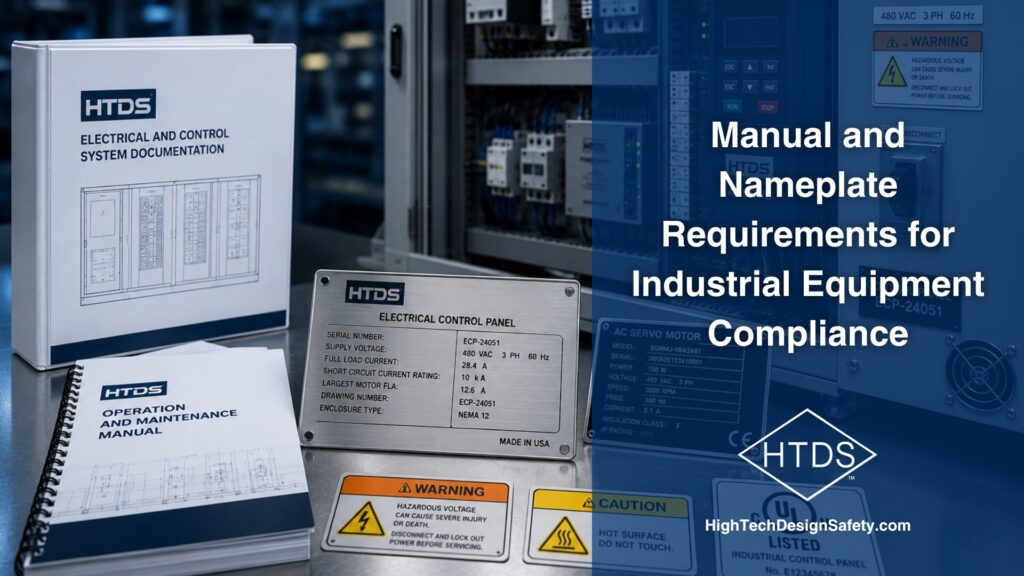
Industrial equipment compliance does not stop at electrical design, risk assessments, or functional safety reviews. One of the most overlooked areas during certification projects is the quality and completeness of manuals, labels, and equipment nameplates.
Missing warning labels, incomplete machine markings, or insufficient operator documentation can delay approvals, create corrective actions, and increase project costs late in the evaluation process.
At High Tech Design Safety, manual and nameplate reviews are a critical part of the conformity evaluation process for industrial machinery and semiconductor process equipment. Standards such as SEMI S2, NFPA 79, IEC 60204-1, IEC 60825-1, and IEC 61010-1 all contain specific requirements for equipment documentation, labeling, and markings.
This blog explores the role of manuals and nameplates in equipment compliance, highlights common requirements across major standards, and explains how manufacturers can simplify the path to market by addressing these items early in the design process.
What You Can Expect From the Video and Blog
- An overview of manual and nameplate requirements in major industrial standards
- Key documentation expectations under SEMI S2, NFPA 79, and IEC standards
- Common compliance gaps that delay evaluations and certifications
- Best practices for machine labeling and operator documentation
- Strategies to streamline conformity reviews and reduce corrective actions
Why Manuals and Nameplates Matter in Compliance
Manuals and equipment markings serve a much larger purpose than simple product identification. They communicate critical operational, maintenance, and safety information to users, service personnel, installers, and inspectors.
During conformity evaluations, certification bodies and safety engineers review documentation to verify that the equipment can be installed, operated, maintained, and serviced safely.
If manuals are incomplete or machine markings are missing, evaluators may not be able to verify:
- Intended equipment use
- Proper operating procedures
- Lockout/tagout instructions
- Electrical ratings
- Laser classifications
- Safety warnings
- Maintenance limitations
- Required operator actions
- Regional compliance markings
As industrial systems become more advanced and interconnected, the importance of clear documentation continues to grow.
Additionally, documentation problems often create downstream delays because many missing items require engineering review, updated drawings, revised labels, and reissued manuals before final approval can occur.
SEMI S2 Manual Requirements
SEMI S2 places a strong emphasis on equipment documentation and operator safety.
Additionally, SEMI S2 requires suppliers to provide manuals based on the originally intended use of the equipment. These manuals must describe the scope and normal use of the equipment while also providing information that supports safe operation, maintenance, and service activities.
The standard also references SEMI S13 for documentation conformance.
Additional documentation requirements include:
- Written instructions for routine tasks
- Lockout/tagout procedures
- Safety-related operational guidance
- Maintenance information
- Service instructions
These requirements are especially important in semiconductor manufacturing environments where complex equipment, hazardous energy sources, and highly specialized maintenance procedures are common.
When documentation is incomplete, manufacturers often face corrective actions that can extend project timelines and impact production schedules.
NFPA 79 Nameplate Requirements
NFPA 79 includes detailed machine nameplate requirements for industrial machinery.
The standard outlines several critical marking requirements that must appear on equipment nameplates. These include:
- Supplier name or trademark
- Model or serial number
- Rated voltage
- Number of phases
- Frequency information for AC systems
- Full-load current for each supply
- Ampere rating of the largest motor or load
NFPA 79 also requires markings to be legible, durable, and plainly visible after installation.
This is an important detail because poorly placed labels or markings hidden behind access panels can create nonconformities during inspections.
Additionally, inconsistent machine markings across product lines can complicate documentation management and increase the likelihood of compliance gaps.
IEC 60204-1 Equipment Marking Requirements
IEC 60204-1 focuses heavily on electrical equipment safety for machinery.
The standard requires incoming power supply enclosures to include durable and visible markings containing:
- Supplier name or trademark
- Certification markings where required
- Equipment type designation or model
- Serial numbers where applicable
These markings help identify the equipment configuration, certification status, and installation details during operation and servicing.
Furthermore, regional legislation may require additional certification marks depending on the intended market.
Because many manufacturers sell equipment globally, nameplate strategy becomes increasingly important. A machine intended for North America, Europe, and Asia may require different labeling considerations depending on the applicable conformity requirements.
IEC 60825-1 Laser Labeling and User Information
IEC 60825-1 introduces additional labeling requirements for laser-based systems.
The standard specifies that custom system labeling requirements depend on the laser class and system configuration.
In addition to physical labeling requirements, the standard also includes user information requirements within the equipment manual.
Laser systems often require:
- Hazard warnings
- Laser classification markings
- User safety instructions
- Exposure prevention guidance
- Service precautions
These requirements become increasingly important in semiconductor, industrial automation, research, and manufacturing environments where laser integration is common.
Failure to properly classify or label laser systems can create significant safety concerns and certification delays.
IEC 61010-1 Marking and Documentation Expectations
IEC 61010-1 contains extensive marking visibility and identification requirements for electrical equipment.
The standard includes several important compliance expectations, including:
- Markings must be visible from the exterior or after opening intended access doors
- Symbols and units must follow recognized IEC conventions
- Graphic symbols used on equipment must be explained in the documentation
- Equipment markings should not typically be located on the bottom of equipment
These requirements support usability, maintenance safety, and operator understanding.
Additionally, proper documentation helps ensure that users can interpret symbols, warnings, and equipment limitations correctly.
This becomes especially valuable during servicing and troubleshooting activities where improper interpretation could create electrical or operational hazards.
Common Manual and Nameplate Compliance Gaps
Many equipment manufacturers wait until the final stages of a project to address manuals and labeling.
Unfortunately, this approach often leads to avoidable delays.
Some of the most common issues identified during conformity evaluations include:
Missing Safety Information
Operator manuals may omit lockout/tagout procedures, servicing instructions, or hazard warnings required by the applicable standard.
Incomplete Nameplate Data
Equipment labels sometimes exclude required electrical ratings, serial numbers, or certification markings.
Poor Label Durability
Temporary labels or low-quality materials may not meet durability requirements for industrial environments.
Inconsistent Documentation
Different versions of manuals, labels, and drawings can create conflicts during the evaluation process.
Missing Symbol Explanations
Standards like IEC 61010-1 require graphic symbols to be explained in the documentation.
Late-Stage Documentation Revisions
Waiting until the end of the project to create manuals and labels often creates schedule pressure and engineering rework.
Best Practices for Equipment Documentation and Labeling
Manufacturers can significantly reduce project delays by integrating documentation planning earlier in the design process.
Several best practices consistently improve certification readiness.
Standardize Documentation Templates
Using standardized templates for manuals, labels, and nameplates helps ensure consistency across projects.
HTDS often supports clients by providing templates for:
- Nameplates
- Critical component tracking
- Project flow documentation
- Conformity planning
Define Applicable Standards Early
Identifying applicable standards early allows teams to understand documentation requirements before final design release.
This is especially important for systems requiring multiple standards simultaneously.
Coordinate Engineering and Documentation Teams
Engineering, compliance, and technical writing teams should work together throughout the project rather than treating documentation as a final deliverable.
Review Markings During Design Reviews
Including label and nameplate reviews during engineering milestones helps identify missing requirements before manufacturing begins.
Validate Documentation Before Final Evaluation
Pre-compliance reviews can identify missing clauses, incomplete warnings, and incorrect labels before formal certification activities begin.
How HTDS Supports Manual and Nameplate Compliance
HTDS specializes in industrial machinery and semiconductor process equipment conformity evaluations.
With more than 1,400 successful projects, HTDS supports manufacturers through:
- Standards evaluations
- Documentation reviews
- Nameplate assessments
- Labeling guidance
- Corrective action support
HTDS also provides support templates and guidance designed to simplify compliance workflows and accelerate approvals.
Because documentation issues are frequently identified late in projects, early collaboration can help manufacturers reduce risk, improve consistency, and shorten time to market.
Simplifying the Path to Market
Manuals, labels, and equipment nameplates are foundational components of industrial equipment compliance.
While they are sometimes treated as secondary deliverables, standards such as SEMI S2, NFPA 79, IEC 60204-1, IEC 60825-1, and IEC 61010-1 clearly demonstrate that documentation and markings are critical parts of the conformity evaluation process.
Manufacturers that proactively address documentation requirements early in the design phase are often better positioned to avoid delays, reduce corrective actions, and improve project efficiency.
As equipment systems continue to evolve, strong documentation practices will remain essential for safe operation, successful evaluations, and long-term compliance.
Summary
Manuals, labels, and equipment nameplates are foundational components of industrial equipment compliance. While they are often treated as secondary deliverables, standards such as SEMI S2, NFPA 79, IEC 60204-1, IEC 60825-1, and IEC 61010-1 clearly demonstrate that documentation and equipment markings are critical parts of the conformity evaluation process.
Manufacturers that address documentation requirements early in the design phase are often better positioned to reduce corrective actions, improve project efficiency, and accelerate certification timelines. Proper planning also helps ensure equipment can be installed, operated, maintained, and serviced safely throughout its lifecycle.
At HTDS, documentation and labeling reviews are integrated directly into the conformity process to help clients identify gaps early and simplify the path to market.
Key Takeaways
- Manuals and equipment markings are critical parts of industrial equipment compliance
- Missing labels and incomplete documentation are common causes of certification delays
- Standards such as SEMI S2, NFPA 79, and IEC 60204-1 contain detailed labeling and documentation requirements
- Laser systems may require additional warnings and user information under IEC 60825-1
- Early documentation planning can reduce corrective actions and improve certification readiness
- Consistent nameplate strategies are especially important for globally distributed equipment
- Proper documentation supports both operator safety and long-term compliance success
Need Support With Equipment Compliance?
Contact High Tech Design Safety to learn how HTDS can support your industrial machinery or semiconductor equipment project with documentation reviews, conformity evaluations, and certification guidance.
👍 Please subscribe to our YouTube Chanel to get more tips, tools and information for your industrial equipment compliance needs and please share this blog. #IndustrialSafety #IndustrialEngineering #EquipmentCompliance
What should you check out next?
A Guide to SEMI S2 Compliance for Semiconductor Equipment Design
NFPA 79 – Electrical Standard for Industrial Machinery Overview with High Tech Design Safety
IEC 60204 – Safety of Machinery – Electrical Equipment of Machines Overview
IEC 61010 Overview – Standard for Safety Requirements for Electrical Equipment
