
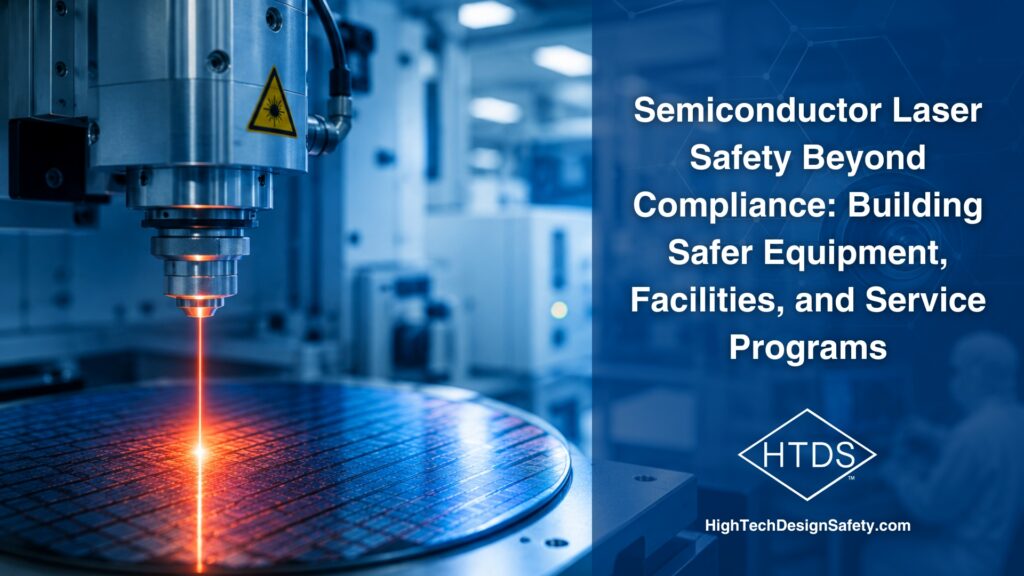
Industrial laser systems play a critical role in modern semiconductor manufacturing. From precision measurement and feature detection to cutting, annealing, marking, and ablation, lasers are deeply integrated into advanced process equipment across the industry.
However, as laser systems become more powerful and more integrated into automated manufacturing environments, the conversation around safety must evolve beyond simple compliance checklists.
Many manufacturers focus heavily on laser classification, interlocks, and warning labels. While these elements are essential, they represent only one part of a much larger safety strategy. True laser safety in semiconductor manufacturing requires a layered approach that considers equipment design, personnel protection, maintenance procedures, medical surveillance, industrial hygiene, and facility-level risk management.
At High Tech Design Safety (HTDS), we frequently see manufacturers underestimate the operational and long-term risks associated with semiconductor laser systems. In many cases, the biggest challenges do not come from the laser beam itself, but from the secondary hazards created around the equipment.
What You Can Expect From the Video and Blog
- A closer look at laser hazards beyond direct beam exposure
- The difference between primary and secondary laser-related risks
- Why maintenance and service personnel face elevated exposure risks
- The importance of medical surveillance and laser safety programs
- How protective housings, interlocks, and procedures work together
- Best practices for integrating laser safety into semiconductor equipment design
Laser Systems Are Expanding Across Semiconductor Manufacturing
Laser technology has become increasingly common throughout semiconductor manufacturing equipment. Smaller low-power lasers are widely used for gauging, measurement, alignment, and detection systems. Manufacturers often reserve higher-powered laser systems for specialized manufacturing processes such as:
- Cutting
- Annealing
- Marking
- Engraving
- Ablation
- High-precision measurements
As manufacturing systems become more automated and interconnected, laser systems are no longer isolated components. Instead, they are integrated into larger process environments where operators, maintenance personnel, service technicians, and engineers may all interact with the equipment in different ways.
This creates a more complex safety environment that requires manufacturers to think carefully about both operational exposure and service-related exposure.
Understanding the Difference Between Primary and Secondary Laser Hazards
One of the most overlooked aspects of semiconductor laser safety is the distinction between primary hazards and secondary hazards.
Most safety discussions focus almost entirely on direct laser exposure. While direct exposure is extremely serious, secondary hazards can create equally dangerous conditions inside semiconductor manufacturing facilities.
Primary Laser Hazards
Primary hazards are the direct effects caused by laser radiation and energy exposure.
These hazards may include:
- Eye damage
- Retinal injury
- Temporary or permanent blindness
- Skin burns
- UV-related skin damage
- Clothing ignition
- Fire hazards
The severity of these hazards depends on several factors, including:
- Laser classification
- Beam power
- Wavelength
- Exposure duration
- Whether the beam is visible or invisible
Invisible laser wavelengths are particularly dangerous because personnel cannot naturally detect or react to the exposure before injury occurs.
Additionally, even lower classification lasers can become hazardous under certain conditions, including prolonged exposure or the use of magnification devices.
Secondary Hazards Often Create the Bigger Operational Risk
Engineering teams frequently underestimate secondary hazards during equipment design reviews.
The laser beam itself does not always directly cause these hazards. Instead, they develop from surrounding processes, supporting systems, or the interaction between the laser and processed materials.
Examples of secondary hazards include:
- Electrical shock
- Heated surface burns
- Smoke contamination
- Dust generation
- Airborne particle exposure
- Eye and respiratory irritation
- Toxic material disturbance
- Facility contamination
- UV degradation of insulation materials
- Electrical shorts caused by material degradation
In semiconductor manufacturing environments, contamination control is already a critical concern. Smoke, dust, and airborne particles generated during laser processes can create operational problems that extend far beyond personnel safety.
Without proper controls, contamination may impact:
- Product yield
- Equipment reliability
- Cleanroom integrity
- Preventive maintenance intervals
- Facility uptime
This is why laser safety should never be viewed as an isolated EHS issue. It must be integrated into the broader equipment reliability and contamination control strategy.
Maintenance and Service Personnel Face Higher Exposure Risks
One of the most important realities in semiconductor laser safety is that operators are often not the highest-risk personnel.
Maintenance technicians, field service engineers, and R&D teams frequently face significantly greater exposure potential because they interact with equipment while guards, housings, or interlocks may be bypassed during troubleshooting or servicing.
This creates elevated risk scenarios involving:
- Direct beam access
- Alignment procedures
- Open protective housings
- Defeated interlocks
- Exposed energized systems
- Thermal hazards
- Smoke and particle exposure
Many equipment designs are adequately protected during normal operation but become substantially more hazardous during maintenance activities.
This is why semiconductor equipment manufacturers should evaluate laser safety across the full equipment lifecycle rather than only during production operation.
Why Laser Classification Alone Is Not Enough
Laser classification is a foundational part of safety evaluation, but classification alone does not guarantee a safe implementation.
Laser classes are determined by factors such as:
- Wavelength
- Frequency
- Maximum output power
- Measured beam energy
Laser suppliers often provide classification documentation to manufacturers. However, classifications may no longer remain accurate if:
- Optical systems are modified
- Beam paths are changed
- Power supplies are altered
- System integrations affect output characteristics
Because of this, manufacturers should validate laser output conditions at maximum operating parameters whenever possible.
This becomes especially important when integrating laser assemblies into larger semiconductor manufacturing systems where system-level modifications may unintentionally affect exposure conditions.
Building a Layered Laser Safety Strategy
Effective semiconductor laser safety requires multiple protective layers working together.
No single safeguard should be relied upon as the only protection method.
Protective Housings
Protective housings help contain laser energy and reduce accidental exposure risks. Properly designed housings should account for both operational access and maintenance access.
Interlocking Systems
Interlocks are critical for preventing hazardous exposure when protective barriers are opened or removed.
However, manufacturers should also evaluate how interlocks are managed during troubleshooting, servicing, and maintenance bypass conditions.
Warning Labels and Signage
Laser hazard labeling remains an important communication tool for personnel working around semiconductor equipment.
Labels should clearly identify:
- Laser classification
- Exposure risks
- Required protective equipment
- Service restrictions
Administrative Controls and Procedures
Written procedures remain essential for ensuring consistent operational safety.
Facilities operating laser systems should maintain:
- Laser safety manuals
- Incident reporting procedures
- Auditing programs
- Maintenance procedures
- Training requirements
- Protective equipment procedures
Each jurisdiction may also impose additional registration, inventory, reporting, and operational requirements.
The Role of Medical Surveillance in Laser Safety Programs
Medical surveillance is often overlooked in laser safety discussions, yet it can play a major role in protecting long-term employee health.
For personnel working around higher-classification lasers, medical surveillance programs may include:
- Ophthalmologic evaluations
- Retinal imaging
- Eye health monitoring
- Dermatological examinations
These evaluations help establish baseline health records that can later support incident investigation and post-exposure analysis if an accident occurs.
Medical surveillance programs also reinforce the seriousness of laser exposure risks throughout the organization.
For facilities where laser processing may generate airborne contaminants, manufacturers should additionally evaluate industrial hygiene requirements and respiratory protection considerations.
Semiconductor Laser Safety Requires Cross-Functional Coordination
One of the biggest challenges with laser safety is that responsibility is often fragmented across multiple departments.
Engineering teams may focus on equipment functionality.
EHS teams may focus on procedural compliance.
Operations teams may prioritize uptime and throughput.
Service teams may prioritize rapid troubleshooting and maintenance access.
Without coordination between these groups, safety gaps can emerge during real-world operation.
The strongest semiconductor laser safety programs integrate:
- Equipment engineering
- Functional safety
- EHS management
- Service planning
- Facility operations
This type of collaboration helps manufacturers reduce risk while supporting smoother evaluations and long-term operational reliability.
Summary
Semiconductor laser safety is about far more than preventing direct beam exposure.
The most effective safety strategies consider the entire operating environment surrounding the laser system, including maintenance access, contamination risks, industrial hygiene concerns, electrical hazards, and long-term personnel health.
As semiconductor equipment continues becoming more advanced, integrated, and automated, laser safety programs must evolve alongside the technology.
Manufacturers that proactively address both primary and secondary hazards early in the design process are often better positioned to:
- Reduce operational risk
- Improve serviceability
- Support safer maintenance procedures
- Streamline evaluations
- Minimize redesign delays
- Protect personnel and facility infrastructure
At HTDS, we help manufacturers evaluate semiconductor equipment safety from both a compliance and operational perspective. Our goal is not simply to complete evaluations, but to help clients build safer, more reliable equipment that supports long-term success.
Simplify Your Path to Market
HTDS specializes in semiconductor process equipment and industrial machinery evaluations, helping manufacturers navigate complex safety and compliance requirements with a practical, engineering-focused approach.
Whether your equipment includes advanced laser systems, integrated automation, or specialized process technologies, early safety planning can significantly reduce delays later in the certification and evaluation process.
If your team is preparing for a semiconductor equipment safety evaluation, HTDS can help you identify risks early, improve documentation readiness, and support a smoother path toward market access.
👍 Please subscribe to our YouTube Chanel to get more tips, tools and information for your XXXXXXX needs and please share this blog. #SemiconductorManufacturing #LaserSafety #IndustrialSafety
What should you check out next?
Laser Safety in Semiconductor Equipment: Hazards, Compliance, and Evaluation Process
A Comprehensive Guide to Semiconductor Health and Safety and Industrial Hygiene
A Guide to SEMI S2 Compliance for Semiconductor Equipment Design
