
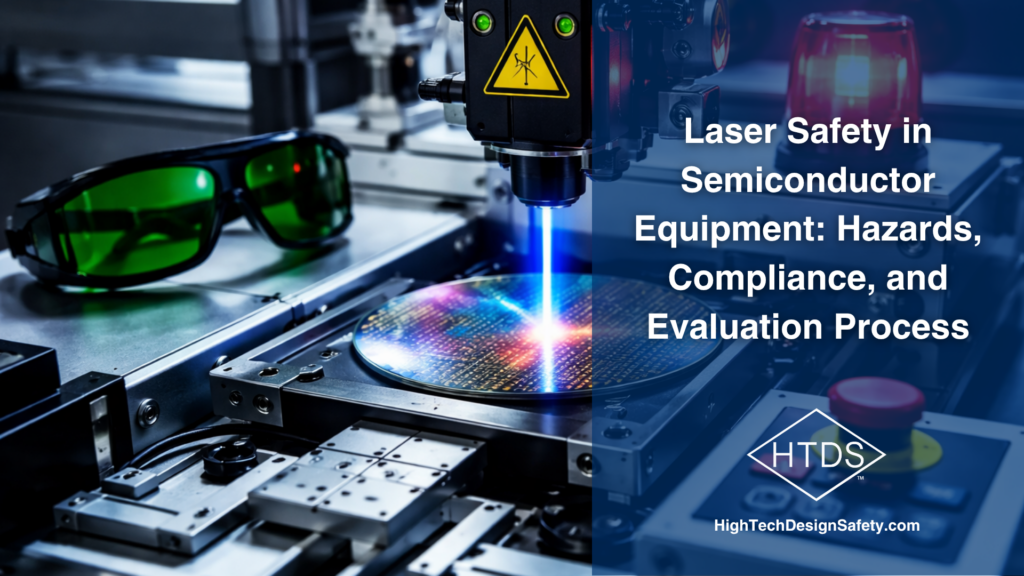
Lasers are a critical component in semiconductor manufacturing and advanced industrial equipment, offering unmatched precision and efficiency. However, they also introduce significant hazards that must be addressed through proper risk analysis, engineering controls, and a structured evaluation process.
For manufacturers seeking UL Certification, CE Mark, or other NRTL approvals, understanding how laser safety integrates into overall industrial equipment safety is essential.
In this blog, we explore laser hazards, system design considerations, and the standards that guide compliance.
What You Can Expect From the Video and Blog
- Understand key laser hazards, including non-ionizing radiation and potential ionizing radiation risks
- Learn how beam paths influence mechanical design and system safety
- Identify required safety interlocking systems and protective measures
- Explore ventilation and exhaust ventilation requirements
- Understand the evaluation process for CE Mark, UL, and global approvals
- Review applicable standards such as IEC 60825, UL Standards, and SEMI requirements
Understanding Laser Radiation Hazards
Laser systems primarily present hazards related to non-ionizing radiation, though high-energy systems may introduce additional risks.
These hazards include:
- Direct exposure to the primary laser beam
- Reflected or scattered radiation from surfaces
- Secondary risks such as burns, fire hazards, and airborne contaminants
A comprehensive risk analysis, aligned with SEMI S10, is required to evaluate these hazards and determine appropriate controls.
The governing laser safety standard, IEC 60825, defines classification levels and corresponding protection requirements.
Beam Path and Mechanical Design Considerations
The beam path is one of the most critical factors in laser safety.
It includes:
- The intended path from source to target
- Optical components such as mirrors and lenses
- Potential unintended paths caused by reflection or failure
From a mechanical design perspective, all beam paths must be contained within:
- Electrical enclosures
- Machine tool enclosures
- Sealed or shielded optical assemblies
These designs must align with NFPA 79, the National Electrical Code (NEC), and relevant IEC standards such as IEC 60204.
Failure to properly control beam paths can result in significant safety and compliance issues during the evaluation process.
Safety Interlocking Systems and Hazardous Energy Control
For higher-class laser systems, safety interlocking systems are required to prevent accidental exposure.
These systems must:
- Disable laser operation when access panels or doors are opened
- Integrate with lockout tagout procedures
- Support hazardous energy isolation during servicing
Interlocks are a key requirement under UL Standards, IEC 61010, and UL 61010, and are critical for achieving certification.
Protective Housing, Materials, and Fire Risk
Protective housings must fully contain laser radiation while also addressing fire risk.
Material selection is especially important, and components often must meet:
- UL 94 V-0 flammability requirements
- Flame test criteria
- Fire risk assessment guidelines
This becomes increasingly important in environments involving:
- Flammable gases
- Pyrophoric materials
- High-energy laser applications
Proper design reduces both safety risks and delays in the certification process.
Ventilation, Exhaust, and Environmental Considerations
Laser processes can generate smoke, particulates, and chemical byproducts that must be controlled.
This requires:
- Proper ventilation systems
- Localized exhaust ventilation
- Consideration of environmental impacts and industrial hygiene practices
In systems involving chemicals or Gas & Chemical Delivery, these controls are essential for both operator safety and regulatory compliance.
Environmental considerations should also be factored into project budget and system design early in development.
Electrical Safety and System Integration
Laser systems must comply with applicable electrical standards in addition to laser-specific requirements.
This includes:
- IEC 61010 and UL 61010
- IEC 62368 for modern equipment
- Integration of circuit breakers, fuses, and over current protection
- Use of Ground Fault Circuit Interrupter (GFCI) devices where required
Proper electrical integration ensures compliance with NFPA 79 and supports safe system operation.
Certification, Conformity, and Documentation
To bring a laser-based product to market, manufacturers must complete a structured evaluation process and demonstrate conformity with applicable standards.
This may include:
- CE Mark for European markets
- UL Certification or other NRTL approvals in North America
- ATEX Certification for explosive environments
Equally important is proper documentation, including:
- Manuals and operating instructions
- Documents Provided to User
- Safety labels and warnings
Incomplete documentation is one of the most common causes of delays in certification.
Applicable Standards and Reference Documents
Key standards for laser systems include:
- IEC 60825 – Laser safety standard
- SEMI S2, SEMI S6, SEMI S14 – Semiconductor equipment safety
- UL 94 V-0 – Flammability testing
- IEC 61010 / UL 61010 – Electrical safety
- IEC 62368 – Equipment safety
- NFPA 79 / NEC – Electrical systems and integration
These reference standards and documents define the scope and requirements for compliance.
Summary
Laser safety requires a comprehensive and integrated approach that aligns with a strong safety philosophy.
Key takeaways:
- Perform a thorough risk analysis early in the design process
- Contain all beam paths through proper mechanical design
- Implement robust safety interlocking systems
- Address ventilation, exhaust, and environmental impacts
- Ensure compliance with IEC, UL Standards, and SEMI requirements
- Complete the evaluation process with proper documentation and certification
Designing safe, compliant laser systems requires more than meeting a single standard—it requires coordination across mechanical, electrical, and environmental disciplines.
At High Tech Design Safety, we support manufacturers through every stage of the evaluation process, from initial risk analysis to final certification.
If your equipment includes laser systems and you are pursuing CE Mark, UL Certification, or other approvals, our team can help you navigate the requirements efficiently and effectively.
👍 Please subscribe to our YouTube Chanel to get more tips, tools and information for your Laser Safety needs and please share this blog. #LaserSafety #IndustrialEquipmentSafety #ProductSafety
What should you check out next? Process To Certification , Cost of Certification , Timeline to Certification
